
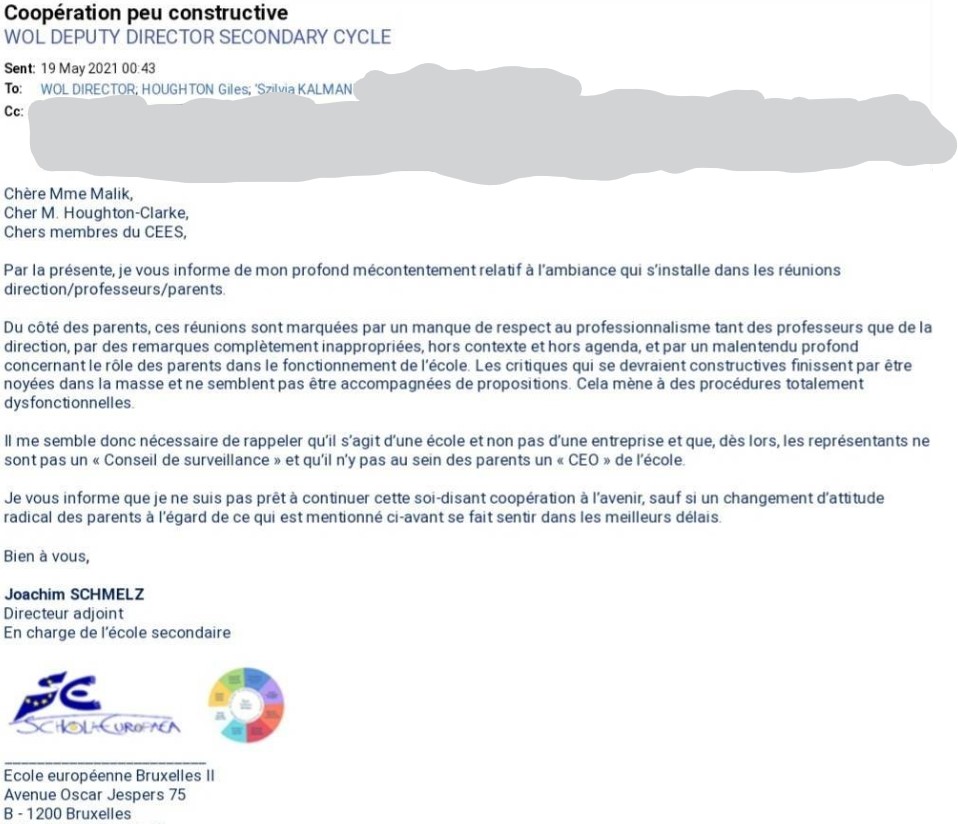
 On the unusually sunny morning of 23 May 2021, The Woluwe Diaries bumped into a rather curious tweet (English translation). As knowledgeable as these Diaries are about how the Woluwe EEB2 parents association (APEEE) tends to operate, I thought it would be helpful to put this tweet into some context. This should be a wake up call to the entire parents community.
Below you will find a Q&A that tries to shed some light on this letter. Now, without further ado, please read on.
What is this letter?
This is an official letter sent on 19 May 2021 by the EEB2 Secondary School Director to the APEEE President, the APEEE Coordinator of the CEES Working Group and to the Director of EEB2. It seems to also have been copied to all members of the CEES.
I do not have time to read all this. Tell me!
It is about the behaviour of parents’ representatives at the CEES meetings. According to the letter, ‘parents’ show a lack of respect for the professionalism of both teachers and management. Moreover, parents give remarks that are inappropriate, out of context and outside the agenda. The school states that it should not be confused with a company and that the APEEE should not behave like a Supervisory Board to the school. It furthermore reminds the parents that there is no CEO of the School, acting on behalf of the parents.
Who are these “parents” mentioned in this letter?
‘Parents’ means the APEEE, since the APEEE Board members represent parents.
What does this letter mean in practice?
By this writing, the Deputy Director seems to suggest that no further meetings will be held between school and the APEEE on matters regarding the Secondary cycle, if the APEEE continues to disrupt the dialogue.
What on earth is the CEES?
CEES stands for Conseil d’Education Elargi du Secondaire in French. It means the Extended Secondary Educational Committee.
What happens in the CEES?
The CEES is a meeting of stakeholders. It is a platform where the stakeholders share information, raise concerns and ask questions. No voting is done.
Who are the stakeholders to the CEES?
The school management, the teachers, the students and the parents through their elected representatives and others invited for their expertise. Four representatives are allowed per stakeholder. Therefore the APEEE sends 4 Board members to this meeting.
Isn’t it exaggerated to call APEEE as parents? I am a parent. I have nothing to do with the APEEE.
The parents of each class, vote for four class representatives (APEEE Full Members) at the start of each school year. The class representatives then vote for the APEEE Board members at the Annual General Assembly (AGM) in January. Therefore, the APEEE represents all parents (including you and me).
Why is the APEEE invited to this meeting? I thought the APEEE only deals with buses, canteen and after school activities.
Although the APEEE looks (and sometimes acts) like a company that offers services to parents, it is in fact a non profit association. It is certainly not a business. Since the APEEE is also representing the parents before the school, it is invited as a stakeholder to the CEES meetings. This allows the school to hear the voice of the parents. The APEEE can contribute in a significant manner to many of the pedagogical or wellbeing projects of the school.
Composition of the APEEE Board and who is part of the CEES workgroup
What do you mean with pedagogical or wellbeing projects?
The list of subjects covered is comprehensive and long:
- the effect of the pandemic on the functioning of the school,
- the Rotation System,
- Bring Your Own Device (BYOD) & Geogebra,
- teacher absences,
- revision of the Substance Abuse Policy of the Secondary School,
- the Political Science course,
- extra support for educational advisors and psychologists from the Central Office,
- the much debated 180 days,
- mental health survey results of the secondary school staff,
- request for external assistance in grief counselling for students,
- measures taken by the Wellbeing Advisory Board
- and so on…
If the APEEE is invited to this meeting, the parents can say what they wish, No? What exactly is the problem?
It seems that the APEEE profoundly misunderstands its role. Instead of acting as a stakeholder on behalf of all parents, the email shows that the school is of the opinion that the APEEE is behaving as a Supervisory Board to the school treating the school as a company, instead of a pedagogical institution. This approach by the APEEE leads to dysfunctional procedures and a deteriorating dialogue. Parents even risk losing their seat at this important table.
There are always two sides to the story.
Minutes of official meetings are the proof. But the real proof of the pudding is in eating it. Let’s ask where they are!
Where can you find the Minutes?
Currently nowhere in public.
In its weekly communication, the school wrote on Friday 21 May that all official meeting minutes will soon be made available for all parents so that there is full transparency. Here is the quote:
For the sake of transparency, the reports of various official meetings, such as the Educational councils, the School Advisory Committee (SAC), the Safety and Health Committee (CSH) or the Board of Governors (CA) will soon be harmonized and centralized by our communication department. These reports will be communicated to all members of the school community in the weeks following the meeting in compliance with confidentiality rules. I hope that this initiative will help reinforcing the efficiency of our communication and the trust of every one of you in our school’s management.
How do you know that these minutes will be reliable and true?
They are approved by all parties who attended the meeting.
I am a primary parent and why are you bothering me with this matter? This is all secondary school stuff.
A situation like this with the school management seriously runs the risk of affecting the relations between the APEEE and the school in all areas. The relations with the primary school may also be affected and let’ s not forget that your child will one day go to secondary school.
I get a headache from this.
Yes it seems to be very serious and a mess.
APEEE did this. APEEE did that. This is not my problem. I do not want to know.
APEEE is all of us whether we like it or not. And for the school “parents” are only represented by the APEEE. According to the letter of the Deputy Director, the current approach of the APEEE is disrupting the functioning of the school. If the school does not function properly our children’s wellbeing will be affected. Therefore, this becomes our collective problem. And if we don’t act now, it will be our joint responsibility.
How can this be fixed?
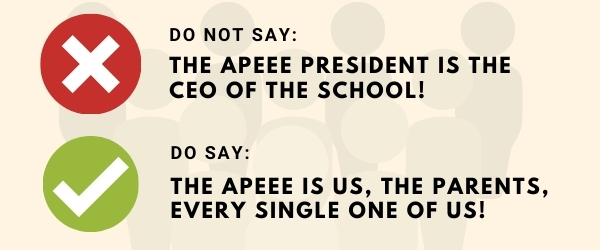
The school listens to multiple partners and the parents are one of those partners. But this role has limitations. According to this letter, the meeting can only work if the APEEE understands its role. But, hey, where there is a will there is a way. By engaging and positively contributing, the APEEE can play a valuable role and have an added value as it has happened in the past. The APEEE should not act as the CEO of the school, the APEEE should put the wellbeing of our children at the heart of its activities and soak it in – We are stronger together!
Wait a minute? If the APEEE is not the CEO of the school, who is the CEO of the school?
I am afraid I have to disappoint you. The school has a Director. Probably when you went to school you also had a principal or a director. Nothing has changed since then. Not even in the European Schools! The School feels that the APEEE is inspecting them like a School CEO. It is a word that describes the feeling of the school regarding the APEEE.
Do you have any questions? If so, do not hesitate to contact me: fabricio.santos@thewoluwediaries.blog.

Fabrício Santos is a parent at the Brussels European School 2 in Woluwe.
As an engaged parent he is often involved in actions that aim at improving and increasing the transparency and accountability of the school’s parents association.